



今日上海
AI宠物市场成孤独人群新宠 - 2026年10月08日
AI pet mkt cat's meow for the lonely
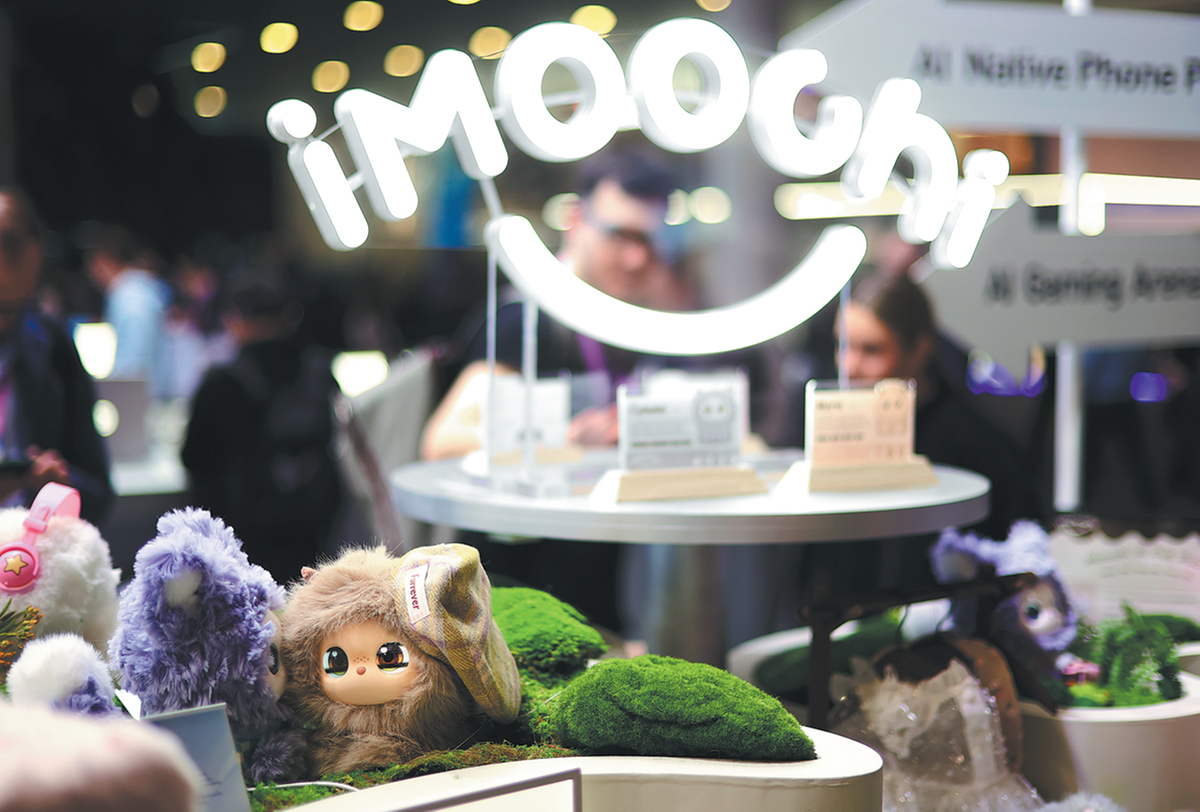
After a long day at work, Monica Chen, a 25-year-old white-collar worker in Shanghai, arrived home. Upon entering her residence, instead of a real pet, what welcomed her was an artificial intelligence pet.
With an authentically fluffy appearance, Chen's AI pet — Qiuqiu — greeted her warmly: "Welcome home, Mommy. I missed you so much. How was your day?" the faux feline asked.
AI-powered pets are emerging as a new consumer technology category in China, attracting startups and major tech firms seeking to tap demand for companionship without the cost and responsibilities of caring for a live animal.
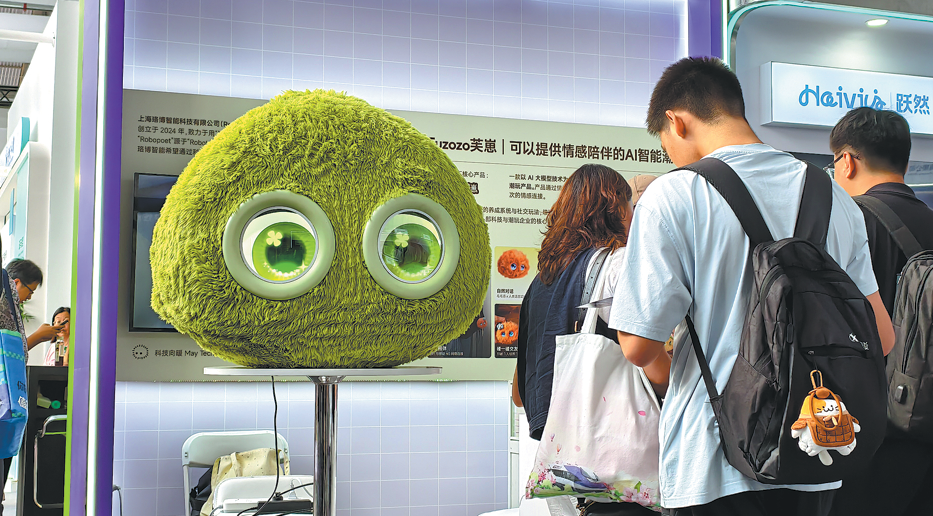
Nubia Technology, a Shenzhen, Guangdong province-based smartphone maker, launched its AI pet robot iMoochi on July 17, joining a growing field that includes Japanese startup Yukai Engineering's Mirumi, Huawei's Smart Hanhan, Ropet from Beijing Mengyou Smart Technology and Fuzozo from Shanghai Robopoet Intelligent Technology.
The products have gained attention among young consumers, particularly people living alone who want the experience of interacting with a pet but face restrictions on keeping animals or lack the time to care for them.
Earlier this year, Wang Yimeng, a 29-year-old internet operations worker living alone in Shanghai, bought a Ropet. She said frequent overtime duties made it difficult to commit to caring for a real pet, while her landlord did not allow animals.
Before buying the device, Wang was not sure if an AI pet would be suitable for her. She now takes the robot between home and work.
"It won't die, get sick or shed. At this stage of my life, that kind of certainty is more attractive than the responsibility that comes with a real pet. I now even take it on business trips, taking it to see the wider world," Wang said.
That trade-off — companionship without uncertainty — is becoming a central selling point for AI pet makers.
China has more than 125 million people living alone, according to market data, while spending in China's urban dog and cat pet markets exceeded 312.6 billion yuan ($46.64 billion) last year, up 4.1 percent from 2024. Average annual spending reached 3,006 yuan per dog and 2,085 yuan per cat, both record levels, said Znkedu, a tech-focused market information platform.
For potential pet owners, however, financial costs are only part of the burden. Time and emotional commitment can be harder to accommodate, companies and industry observers say.
AI pet makers are therefore increasingly emphasizing emotional interaction rather than hardware specifications alone.
Lin Xianping, an associate professor at Hangzhou City University, said: "With the entry of major tech companies and capital-intensive industries, the AI pet sector has quickly become popular. The core logic is to precisely meet the huge lonely-economy needs of China's solitary population, fill the market gap of traditional pets with high time and energy requirements, and become a new category of emotional companion product for young people."
Nubia said iMoochi uses an emotion-savvy AI model and voiceprint recognition to distinguish its owner from others. Touch sensors placed on its head, back, nose and limbs allow the robot to respond differently when it is stroked, picked up or shaken.
The company has also developed five different personalities for the robot — Hopami, Mimiu, Cynomi, Mogogo and Morin — as it seeks to encourage longer-term interaction.
The approach reflects a broader shift in the AI hardware market, where companies are attempting to turn basic interaction with machines into more personalized and persistent relationships.
"AI pets are not simply replacements for traditional pets," said industry observers. "They are increasingly being designed around the emotional needs of consumers."
Shanghai Robopoet's AI companion toy Fuzozo offers another example. Its characters are based on the traditional Chinese five elements — wood, fire, earth, metal, and water — with five colors and different behavioral characteristics.
The company has adopted a hardware-plus-subscription model. The device costs 399 yuan and comes with a daily allowance of free interactions. Users can wait for the allowance to replenish or pay for additional conversational access.
That model points to one of the industry's biggest unanswered questions: whether AI pet companies can generate recurring revenue after initial hardware sales are transacted.
Investment activity suggests that investors see potential in the category. More than 20 financing deals have taken place in China's AI toy and emotional-companion hardware sector over the past year, Znkedu said.
In June, Robopoet announced that it had raised tens of millions of yuan in an angel funding round. The round included Zhu Xiaohu, managing partner at GSR Ventures, who had previously said he was not optimistic about some early-stage embodied-AI projects.
Big tech is also entering the market segment.
Huawei and Robopoet jointly developed Smart Hanhan, an AI pet positioned as an emotional companion and "soul confidant". The product sold out shortly after launch, according to the companies.
Nubia's iMoochi is priced at 1,699 yuan, or 1,778 yuan with a cloud-shaped charging dock. Its launch marks a more direct push by a handset manufacturer into AI companion hardware.
ZTE, a major shareholder of Nubia, has described the product category as a new type of "AI terminal". The strategy suggests that smartphone companies are looking beyond phones and wearables for new ways to establish daily interaction between consumers and AI.
Experts said AI pets offer several traits that make them attractive as consumer AI devices. They can be used frequently, develop personalized interactions with owners and generate social-media interest, while requiring considerably less hardware and engineering investment than humanoid robots.
But commercialization remains a challenge.
Znkedu reported that many products in the sector still rely primarily on hardware sales. Revenue streams such as subscriptions, digital skins and virtual items have yet to demonstrate a clear and sustainable business model.
The challenge is particularly important because the economics of AI pets may differ from those of conventional consumer electronics. Companies must not only persuade consumers to buy the core hardware, but also give them enough reason to continue interacting with it — and potentially paying for it — months or years after the initial purchase.
For now, the sector's hope is that emotional attachment can turn AI-enabled hardware into a recurring part of consumers' daily lives.
Whether that attachment can support a sustainable business model remains to be seen.
"At present, although the sector is hot, the industry has not moved beyond being seen as 'high-end toys'. Most products rely on novelty to boost short-term sales, with formulaic interaction modes and weak emotional sustainability. User repurchase and long-term retention numbers are insufficient, and a stable category value proposition has yet to emerge," said Lin from Hangzhou City University.
"To achieve long-term development, the industry should not aim to compete with or replace live pets, but must leverage tech-driven emotional companionship to carve out a distinct niche. Through more anthropomorphic and sustainable AI interactive experiences, it can break free from the label of 'merely a novelty toy'," he added.
Source: China Daily
