


今日上海
ART PLUS上海展将目标对准首次买家,因艺术市场趋于稳定 - 2026年09月06日
ART PLUS Shanghai looks to first-time buyers as art market stabilizes
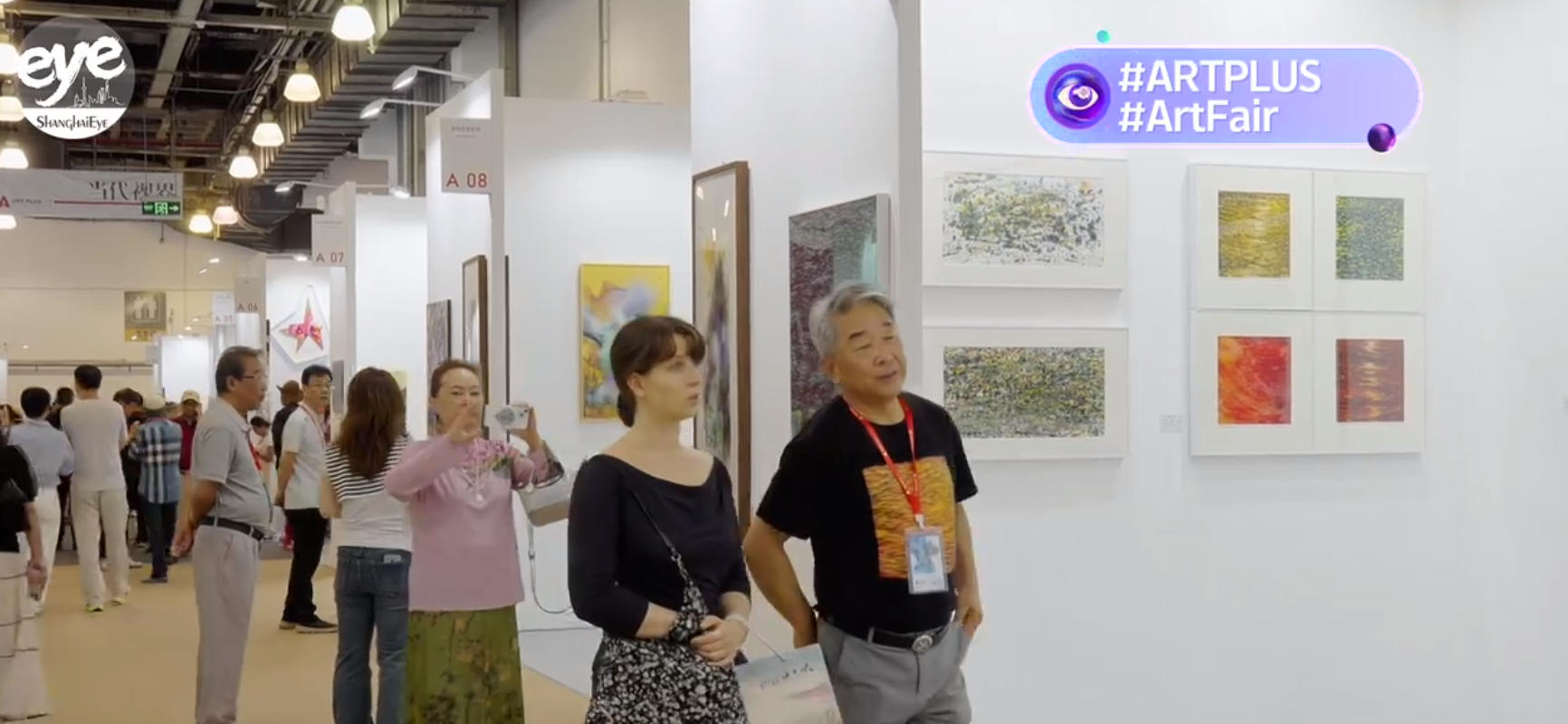
At the 2026 ART PLUS Shanghai International Fair, interior designer Ms. Fan arrived looking for works she might recommend to clients. She left as a buyer.
The 99-Yuan Horse
“I’ve just bought this horse,” she said, standing near a piece whose fluid lines and color had stopped her. “This version costs 99 yuan and does not come with a collector’s number. Because I think its overall color tone, like the fluidity of this horse, is really excellent, and I especially like it.”
She had also ordered another work, this one for 399 yuan. If it were for her own collection, she added, she would prefer something with an official number or certification.
Her purchase sits far below the fair’s best-selling range of 8,000 to 20,000 yuan. But the path it represents, beginning with a small work at a manageable price, is exactly what organizers are trying to establish.
A Younger Collector’s Calculus
“Over the past two or three editions, our buyers have increasingly been around 30, while collectors used to be mostly over 40,” said Bobby Gu, director of operations for ART PLUS Shanghai International Fair. “Experienced collectors may consider asset allocation and the financial attributes of art. Younger collectors are more willing to pay for the emotional value a work gives them. They may find the first work in their collection at our fair. That is why both the choice of work and its price are crucial to attracting and developing new collectors.”
The broader market remains cautious. In 2025, art sales in China rose by just over one percent to 8.5 billion U.S. dollars, a stabilization rather than a strong recovery. Yet within the fair, galleries were adjusting to a different kind of buyer.
Galleries Adapt to New Budgets
Gx Gallery brought 120 works by 43 artists from around 20 countries, with prices ranging from 2,000 to 280,000 yuan. Rising transport costs have encouraged the gallery to focus on smaller pieces.
“Many collectors are gradually regaining confidence in art,” said Kevin Bao, curator of Gx Gallery. “They are no longer focused only on traditional techniques. They pay more attention to their own response and buy what they genuinely like. They also have a clear budget, so they may choose smaller works.”
During installation, a young visitor asked to buy a digital drawing priced at around 8,000 yuan. The medium may not fit a traditional definition of painting, but that was part of its appeal.
Tradition Meets Novelty
Change is not limited to first-time buyers. Guo Xiong, a collector who mainly acquires traditional Chinese painting and calligraphy, especially works by Shanghai-school artists, found himself drawn to a butterfly installation at the fair.
“I mainly collect traditional Chinese painting and calligraphy, especially works by Shanghai-school artists,” he said. “But after visiting the fair this year, I have become interested in many newer forms of art, and I am considering buying some. I just saw that butterfly installation. I think it’s very novel, and I noticed a lot of people were taking photos of it just now. The colors are also very beautiful.”
At Hanguang China, porcelain designs created for APEC and China International Import Expo banquets were on display. In the past, the booth mainly featured large vases and expensive pieces. Now, tableware sets can be bought separately, and some smaller pieces cost only 1,000 or 2,000 yuan.
“The economy has indeed been sluggish these past two years,” said Li Yang, deputy director of the design and R&D department at Hanguang China. “But overall, we see that the entire Chinese ceramic ware market is actually on the rise. People are paying greater attention to the objects themselves, as well as quality of life and culture. The market for functional vessels has actually grown considerably over the past two years.”
Nostalgia as a Gateway
At Tingdeco Shanghai Art, a large installation incorporates wrappers from 288 pieces of Shanghai-made toffee. Old monthly bus passes and scarf designs drawn from the city’s visual archives appear in contemporary works.
“We want to move toward more contemporary, trend-driven art, so younger people can experience Shanghai’s art, Shanghai’s culture and Shanghai’s character,” said Xu Yiwei. “We have a lot of collectors born in the 1970s and 1980s. For them, this piece of toffee has a different impact: it brings back a memory.”
Familiarity, however, is not the only route to interest.
Where Art Meets Science
Curator Zane Mellupe, founder of WhyWhyArt and vice president of the European Arts & Science Association, brought together artists exploring the relationship between art and science.
“I think in general, not only in China, but also all around the world, the topic of arts and science and the connectivity of it, which of course has always been there, is more and more important,” she said. “It’s not only the form, it’s the content and the ability to talk about. The content is important. Creating new concepts, creating even new techniques for artists or technologies that is progressing together is something that society is constantly experiencing.”
Several pieces in that section had already sold by opening day.
A Market Rebuilding from the Ground Up
In 2025, smaller galleries worldwide recorded double-digit sales growth. Nearly half of the buyers galleries sold to last year were new to those businesses, while art fairs accounted for 35 percent of dealer turnover. The market is no longer simply waiting for established collectors to return. It is working to create new ones.
That does not amount to a broad market rebound. But it shows how demand is being rebuilt from both sides: galleries are changing scale, format and price, while buyers are bringing personal taste, memory and curiosity into decisions often framed in terms of investment.
Buying becomes collecting not at a fixed price threshold, but when the object begins to carry something personal, an emotional response, a memory, a certification, or simply a place on the wall that feels like a beginning.
Source: Shanghai Eye
