



今日上海
远景科技加速推进人工智能与能源的融合,以进一步开拓全球市场 - 2026年06月25日
Envision ramps up AI-energy integration to further tap global market
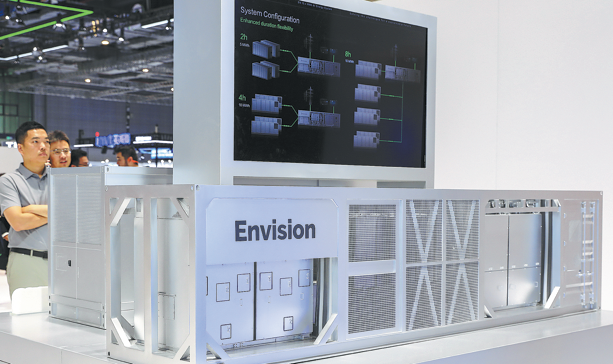
Believing that the new energy system is the ultimate solution to the expansion of artificial intelligence, green technology company Envision Group plans to step up investments in integrating AI into its energy sector to ensure the technology's evolution ultimately secures a winning edge.
China's expansion of its power generation capacity serves as vital support for its pursuit of global AI leadership, as the low-cost electricity is a strategic asset to fuel its data centers and compute-intensive research and development, said Sun Jie, chief sustainability officer and vice-president of Envision Group.
"While surging electricity demand presents a formidable grid challenge worldwide, China's robust energy infrastructure and rapid expansion of renewable capacity uniquely position the country to convert this power challenge into a global competitive advantage in the AI race," he said.
As computing and power infrastructure share deeply intertwined underlying technologies, Sun noted that the entity mastering these innovations and deploying them cost-effectively will ultimately lead the global market.
To leverage this, Envision plans to step up investment utilizing cutting-edge technology to build new energy systems and drive green new industries.
The company has recently announced an ambitious plan to construct 5 gigawatts of green AI computing centers across global desert regions, including the Gobi Desert, by 2030, eyeing to build stable, eco-friendly, and cost-effective infrastructure for the AI era.
Industry experts believe China has established the most comprehensive production system globally, with production capacity now accounting for approximately 60 percent of the global total.
In 2025, China's total transformer exports reached 60 billion yuan ($8.82 billion), representing a year-on-year increase of over 20 percent, said Cai Yiqing, secretary-general of the power equipment branch of the China Electricity Council.
The interplay of AI and the energy sector has moved from simple one-way support to deep integration, Sun said, adding that this synergy has become the core pathway for cultivating new quality productive forces and building a global energy powerhouse.
This corporate push aligns closely with China's national policy direction.
According to an action plan recently issued by the National Energy Administration, China aims to significantly increase the clean energy supply capacity for AI computing infrastructure by 2030, while deeply embedding AI applications across the energy sector.
The guideline seeks to open high-value application scenarios for AI, unlock the value of energy data, and strengthen AI model innovation within the energy field.
According to the NEA, China established 42 massive-scale intelligent computing clusters last year, pushing the total electricity consumption of national computing centers to 170 billion kilowatt-hours.
To capture these burgeoning global opportunities, Envision is delivering scene-specific solutions tailored to diverse regional grid needs.
Overseas markets, either grid-connected or off-grid scenarios, the opportunities are massive, said Sun.
In remote parts of Southeast Asia, such as off-grid islands in Indonesia and the Philippines, deploying small-scale renewable microgrids combining wind, solar, and storage will provide local communities with stable power and replace costly diesel generators, while in isolated mining districts across Africa and Australia, integrated energy solutions can substantially slash energy costs, offering a far greener profile, he said.
"China maintains a competitive edge in this regard. Both computing and power infrastructures are backed by a multitude of deeply linked technologies. The ultimate winner will be whoever can master these innovations and apply them cost-effectively," Sun said.
Source: China Daily
