



经济新闻
美团在上海西岸启动中国第二个无人机配送网络 2026-09-14
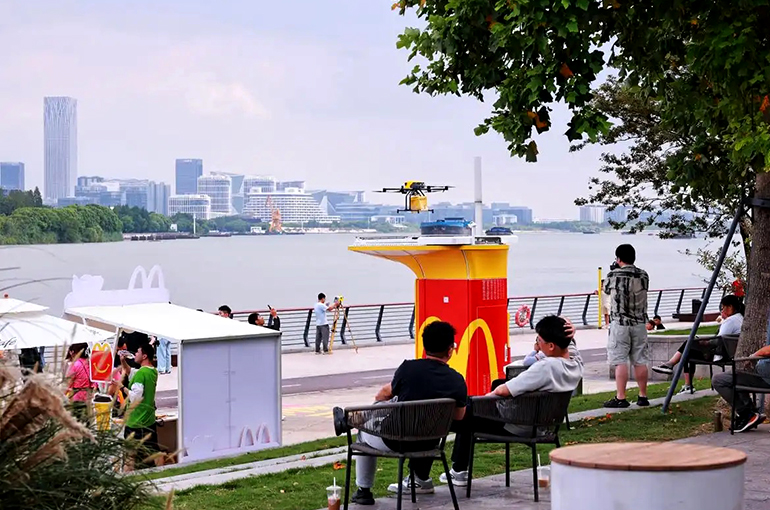
The second low-altitude aerial network of Chinese food delivery giant Meituan has officially commenced operations at Shanghai West Bund, the area along the Huangpu River in the city’s central Xuhui district.
Bypassing congested ground traffic, food delivery by drone is faster and more convenient, a representative for Meituan’s unmanned aerial vehicle business said at the launch ceremony on Sept. 10. It can take as little as 10 minutes from ordering to delivery, cutting waiting time and ensuring food is delivered as fresh as just after being prepared, the representative added.
Meituan entered the low-altitude delivery business in 2017 and completed its first drone delivery to real customers in Shenzhen in early 2021. Its first drone delivery network entered commercial operation in the Chinese southern city in May. In December 2022, the company launched single-route, pilot drone delivery operations in Shanghai’s suburban Jinshan district.
Nearly 20 food and beverage chains, including McDonald’s, Amoy Teas, and MStand, have joined Meituan’s drone delivery platform in Shanghai. The number is expected to exceed 40 by the end of the year.
Drone delivery fees are not fixed, as temporary surcharges may apply due to tight capacity in bad weather, during holidays, and in special scenarios such as scenic spots and parks, a Meituan executive told Yicai. But under normal circumstances, drone delivery fees largely match conventional ground delivery charges, the executive noted.
Meituan’s continuous investment in low-altitude logistics in recent years reflects fiercer competition in last-mile food delivery, logistics expert Zhao Xiaomin told Yicai. Low-altitude logistics can improve delivery reliability and serve as backup capacity, especially in extreme weather, he added.
Meituan’s low-altitude logistics model is not designed to replace ground riders but to supplement delivery capacity, Zhao explained. Successful operations in Shenzhen and Shanghai are expected to help roll out the service in other major provincial capitals and build a standardized, replicable operating model, he noted.
Zhao believes that low-altitude logistics can also test operators’ coordination with merchants. Meituan is likely to expand the service to more coffee shops, hotels, and chain retailers to sharpen its differentiated competitiveness.
The low-altitude economy still faces hurdles, including airspace management, compliance, and safety, Zhang Yi, chief executive officer of iiMedia Research, told Yicai. Other challenges, such as mid-air collision avoidance, emergency landing, noise, and falling objects, still need to be addressed, and relevant regulatory rules remain to be further clarified, he pointed out.
Corporate competitiveness does not merely lie in being the first to fly drones, but also in integrating flight routes, landing infrastructure, aircraft, delivery orders, and safety management into a viable long-term business model, according to Zhang.
Future industry competition will center on technology, scale, customer base, and capital expenditure, Zhao said, adding that operational performance will hinge on sufficient flight routes and scale.
Source: Yicai Global
