


经济新闻
中国AgiBot创始人称,该公司计划通过推动生态系统建设,在2027年实现14亿美元的营收目标 2026-04-20
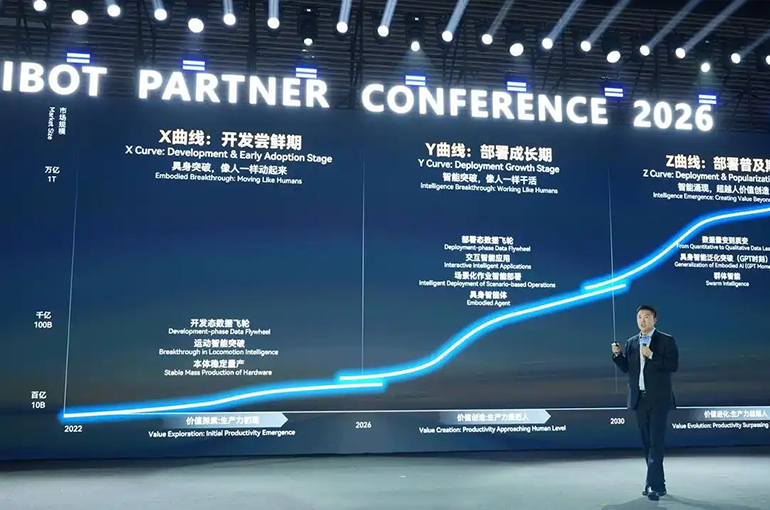
Chinese humanoid robotics startup AgiBot has set its sights on CNY10 billion (USD1.4 billion) of revenue next year, with founder Deng Taihua expressing confidence in achieving the target because of a new ecosystem initiative and the firm’s own reading of where embodied-artificial intelligence is headed.
Surging deliveries have led to fast revenue growth over the past three years, Deng said at AgiBot’s partner conference on April 17. But “AgiBot isn’t in a hurry to pursue profitability,” Deng pointed out. “We’re still focused on the future.”
Revenue stood at CNY1.1 billion (USD147 million) last year, up from CNY60 million (USD8.4 million) in 2024 and CNY300,000 (USD42,000) in 2023, when the privately held company was set up, said Deng, who is also chairman and chief executive. Total shipments stood at 10,000 units as of March 31, compared with 5,000 at the end of last year and 1,000 in early 2025, he said.
“Sufficiently large sales volume can dilute unit R&D costs,” he noted. “As sales volume increases rapidly, losses are expected to continue to narrow, and once the inflection point of net profit is reached, the company's profits will increase rapidly.”
AgiBot has no urgent need for financing in the primary market as it has "self-sustaining" capabilities and sufficient capital, said Peng Zhihui, the Shanghai-based company’s co-founder, president, and chief technology officer.
At the conference, AgiBot launched its Yuansheng Ecosystem Program, an ecosystem-building initiative that involves a CNY2 billion investment over the next five years to foster industrial research, academic innovation, talent training, ecosystem-partner growth, and developer-community operations.
"AgiBot will simultaneously advance mass production of robot platforms, iteration of AI models, open-sourcing of data, and building of ecosystem platforms," said Peng. The goal of these efforts is to propel embodied-AI from an isolated capability to a foundational capability that can be used by the entire industry, he noted.
In addition, AgiBot launched four new robot platforms, six artificial intelligence models, and seven practical industrial application solutions for robots, while also unveiling the full-stack ecological technology system AI Machine Architecture.
Investment Focus
AgiBot is maintaining an investment-focused strategy at this stage, building product competitiveness through saturated research and development investment to support rapid growth in shipments and sales revenue, according to Deng.
"The real watershed for the embodied intelligence business is not just applying AI models to the physical world, but having our products enter real work scenarios," Peng said, adding that AgiBot's business logic has shifted from merely selling robots to delivering tangible application results over the past two years, with the core indicator being whether sufficient value is created for customers.
Since late last year, AgiBot has spun off Qingtianzu, Lingjie Dian, Mifeng Technology, and AgiBot Kuotuo into subsidiaries, focusing on robot leasing, dexterous hands, embodied intelligence data platforms, and quadruped robots, respectively. A key executive leads each unit.
“We've spun off some core businesses and run them as subsidiaries to better promote the professional development of related businesses," Peng said. For example, AgiBot Kuotuo was set up by separating the quadruped robot business and focuses more on scenario-specific applications and achieving faster commercialization, he said.
With the support of AgiBot's overall capabilities, the units can hopefully quickly grow into leaders in their respective niche markets, Deng noted.
AgiBot has also invested in more than 20 early-stage companies over the past one and a half years, with the aim of forming supply chain synergy and boosting the vigorous development of the whole industry, Deng said. It plans to set up a venture capital arm to advance its supply chain investment business this year, he revealed.
The four units can conduct independent financing, while their products can serve AgiBot and other companies, Cai Bingzhen, director of Gaogong Robot Industry Research Institute, told Yicai.
AgiBot must overcome several challenges to achieve revenue of CNY10 billion next year, according to Cai. For instance, multi-scenario deployment demands higher robot stability and generalization ability of AI models, as well as customer acceptance, Cai noted, adding that as mass production scales up, supply chain management difficulty will increase exponentially, testing the supply capacity of component manufacturers and the development of the entire ecosystem.
Source: Yicai Global
